
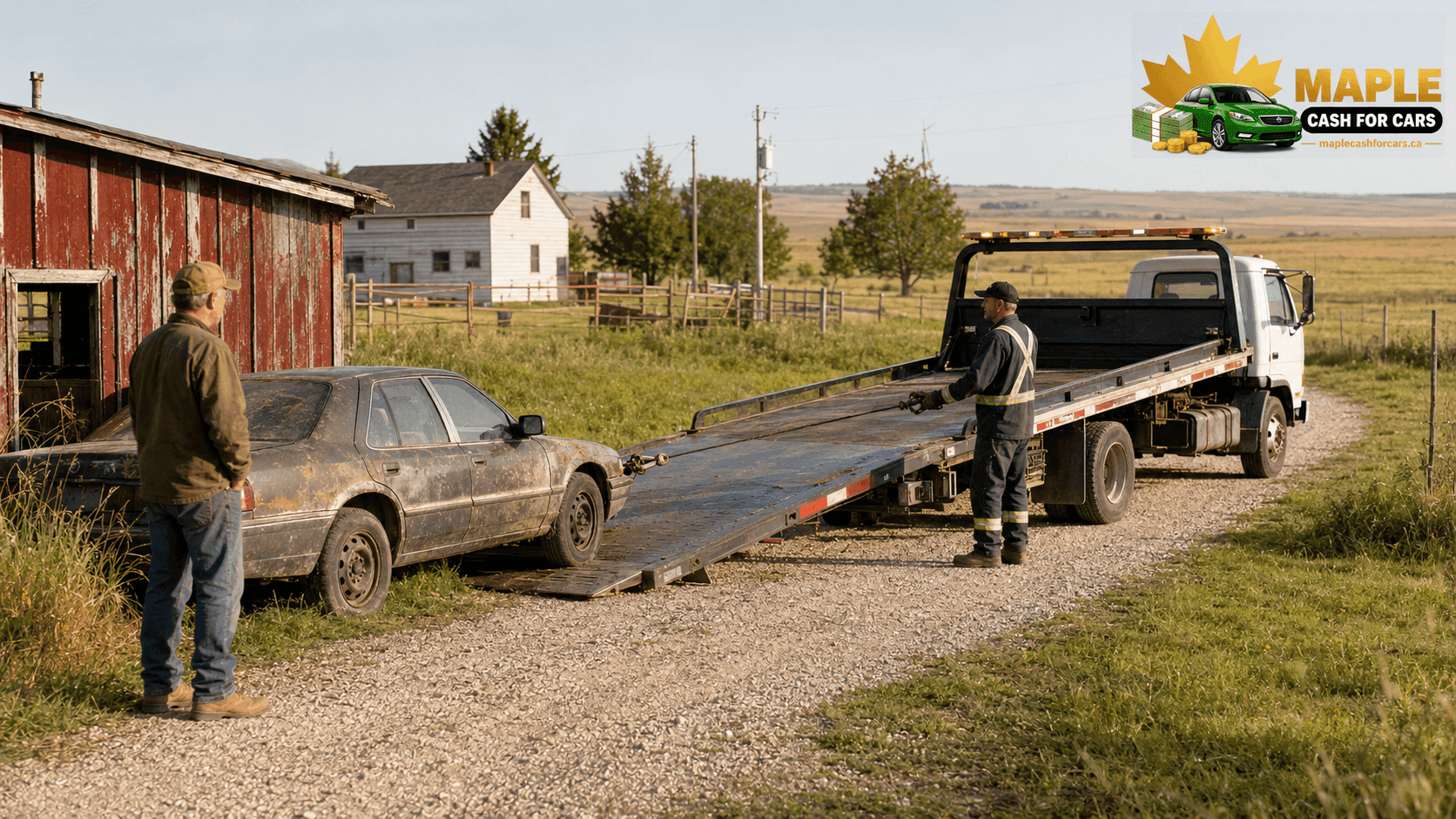
Every farm in Alberta has one. The half-ton that hauled its last bale in 2009. The Cavalier parked behind the quonset "for parts" that nobody ever pulled. The grain truck with a seized engine slowly became part of the landscape.
City junk car guides tell you to "get a quote and schedule free towing" - advice written by people who've never watched a two-wheel-drive tow truck try to cross a soft field in April. Selling a junk vehicle from a farm or acreage is a different job entirely, with different equipment, different paperwork wrinkles, and different money on the table. Here's how rural Alberta pickup actually works, and how to avoid the mistakes that turn a $600 payout into a cancelled appointment.
The First Question Every Rural Seller Should Ask |"What Truck Are You Sending?"
In Calgary, any flatbed can winch a dead sedan off a paved driveway. On an acreage, the equipment matters enormously. Before booking anything, tell the buyer exactly where the vehicle sits and ask what they're bringing. The honest ones will ask you questions first: Is it on gravel or grass? How far from the approach? Are the tires holding air? Do the wheels turn?
A vehicle that's been parked for fifteen years often has seized brakes, sunken rims, or a frame half-swallowed by the ground. That's not a standard tow - it may need a winch with serious cable length, skates, or even a deck truck. Companies that regularly serve rural Alberta carry this gear. Companies that don't will show up, look at your field, and either leave or knock $200 off the agreed price on the spot. Asking the equipment question upfront filters out the pretenders in one phone call.
Free Towing Isn't Always Free Past the City Limits - Here's the Real Math
"Free towing" is the industry's favourite phrase, and within city towing zones it's usually true. But rural pickups cost the buyer real money in fuel and hours, and that cost comes from somewhere. It typically shows up one of three ways:
- A lower cash offer. The tow is "free," but your quote is $150 lighter than the same car would fetch in town.
- A distance threshold. Free within a set radius, a per-kilometre charge beyond it.
- A multi-vehicle condition. Genuinely free - if you have two or more vehicles worth the trip.
None of these are scams; they're economics. The mistake is not asking. Get the quote as a single all-in number - "cash in my hand after the truck leaves" - and confirm in writing that nothing gets deducted at pickup. If a buyer won't commit to a firm number until the driver "takes a look," keep calling around.
The Rural Seller's Secret Advantage| Volume
Here's what city sellers can't do: bundle. If your property has a junk truck, a dead riding mower, an old cattle trailer, and a pile of scrap tin, you've turned a marginal trip into a profitable route stop. Buyers who might lowball a single distant vehicle will sharpen their pencil dramatically for a full load - some crews will even do complete acreage vehicle cleanups at once.
Before you call, walk your property and inventory everything with wheels or significant steel. Mention all of it in the first conversation. Sellers routinely report better per-vehicle prices on bundled pickups, and you clear years of accumulation in a single afternoon.
The Paperwork Problem Nobody Warns You About| The Truck With No Papers
Farm vehicles create a documentation headache that city guides never address. That truck that only ever ran between fields may not have been registered in twenty years. The bill of sale from when Dad bought it in 1994 is long gone. Sometimes the registered owner has passed away and the vehicle simply stayed.
Alberta's rules against buying undocumented vehicles exist to stop theft, and legitimate AMVIC-licensed buyers take them seriously. But "no current registration" is not the same as "no proof of ownership." What buyers can typically work with:
- An expired registration in your name - usually fine.
- A VIN search confirming no liens and no theft flags.
- A statutory declaration of ownership, sworn before a commissioner for oaths - the standard fix for long-forgotten farm vehicles.
- For estate vehicles, letters of administration or a grant of probate connecting you to the deceased owner.
Sort this out before pickup day. A driver who arrives to find ownership questions will leave empty-handed, and you'll have burned your best-priced buyer.
Timing Is Everything| The Rural Alberta Pickup Calendar
City pickups happen year-round. Rural pickups live and die by ground conditions:
- Spring breakup is the worst season. Thawing fields and soft approaches mean crews either can't reach the vehicle or risk getting stuck themselves. Many rural operators book spring pickups weeks out and only for accessible locations.
- Mid-summer to freeze-up is prime time - firm ground, long daylight, and crews actively booking rural routes.
- Deep winter is surprisingly good. Frozen ground carries a deck truck beautifully, and a vehicle that's unreachable in May can roll out easily in January. The catch: it needs to be dug out and not frozen into ice.
If your vehicle sits in a low spot or behind a seasonal slough, plan the sale around the ground, not the calendar.
Prep That Actually Adds Money (30 Minutes, Tops)
You don't need to clean it. You do need to: clear a path wide enough for a deck truck, check the cab and box for anything you want to keep (rural trucks hide tools, chains, and the occasional registration from 1998), remove personal plates, and photograph the VIN plate and any major damage for your quote. If wheels are sunk, mention it. Surprises at pickup only ever move the price one direction - down.
The Bottom Line
Selling a junk car from an Alberta farm or acreage comes down to four moves city sellers never think about: verify the buyer's equipment can actually reach your vehicle, lock in an all-in price that accounts for distance, bundle everything metal on the property into one trip, and fix the paperwork gap before the truck rolls up your approach. Do those four things and that rusted half-ton behind the barn stops being scenery - and starts being a cheque.