
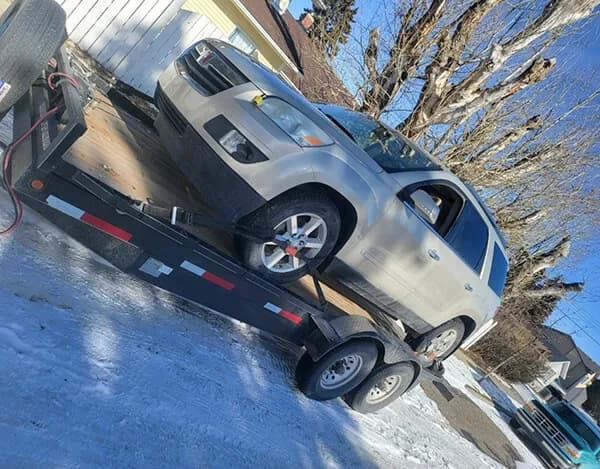
So here's a thing that's been confusing a lot of Calgarians lately.
You called around back in 2022, maybe early 2023. Three wreckers, three quotes, all somewhere between eleven hundred and thirteen hundred bucks for that old Corolla in the driveway. Felt fair. You held off because you weren't quite sure what to do with the car yet, or you were waiting for the spring, or you just kept putting it off. Now you finally pick up the phone in 2025 and the offers come in at three hundred. Maybe four hundred if you're lucky.
Same car. Same city. Same wreckers, in some cases. So what happened?
Honestly? Nothing happened to your car. It's still the same pile of steel and copper and rubber it was eighteen months ago. What changed is everything around it.
A junk car isn't really a car when you sell it. It's a little portfolio of raw materials, and those materials get priced on global commodity markets that have absolutely nothing to do with Calgary. When those markets crash, your offer crashes with them. The wrecker can't pay you for value that doesn't exist further down the chain.
Let me explain what actually moves the number. There's three big things at play, and once you see how they fit together, the $400 quote starts making a lot more sense.
The steel thing
Roughly two thirds of your car by weight is steel. When it gets shredded down (usually at a yard out by Edmonton, sometimes hauled all the way to Manitoba), that steel gets priced against a benchmark called HMS 1&2. Heavy Melting Steel. Boring name. Big deal.
In 2022, HMS scrap was trading at around $450 USD per metric ton. By the middle of last year it had slid under $300. That single drop took maybe $250 off your car right there, before anyone even looked at the tires.
Why did it drop? China. Almost always China. Chinese construction was supposed to bounce back after Covid, and instead the property sector started falling apart in late 2022 and basically hasn't stopped since. Less Chinese demand means more global scrap looking for a buyer. More supply chasing less demand, prices go down. That's pretty much all there is to it.
Throw in shipping rates, tariffs, and electricity prices for the mills, and your local wrecker is working with a way smaller margin than they were two years ago.
The catalytic converter situation
Okay this one is huge. And almost nobody explains it to people who are trying to sell their car.
Your catalytic converter has three precious metals inside — platinum, palladium, and rhodium. Trace amounts. Tiny. But valuable enough that for a stretch in 2021 and 2022, the cat on a domestic V6 was worth more than the rest of the car put together.
Rhodium went absolutely nuts during that stretch. It hit something like $29,000 USD an ounce at the peak. An ounce. The cat off a 2014 Highlander? Easily $600. So when a wrecker quoted you $1,200 for the whole car back then, what they were really doing was paying you maybe $400 for the metal and frame, plus another $700 or $800 for what was bolted to your exhaust pipe. Then they'd ship the cat off to a refinery and still come out ahead.
Now look at this year. Rhodium is back down around $4,500. Palladium dropped more than half from its peak. That same Highlander cat? Worth $180, maybe $200 on a really good day. The wrecker can't pay you what the cat used to be worth because nobody's paying them what it used to be worth either.
This single thing, the rhodium and palladium crash, accounts for most of the difference between your 2022 quote and your 2025 quote. Most of it. Not the steel drop, not labour costs, not inflation. Just the metals inside one little box on your exhaust.
The slow shrinking of newer cars
Here's something else nobody mentions. Newer vehicles are worth less to wreckers, full stop.
Manufacturers have been swapping out steel for aluminum, composites, high-strength alloys, and plastic anywhere they can. A 2008 Silverado has noticeably more recoverable metal than a 2018 version of the same truck. The 2018 is lighter, uses more aluminum (which is harder to process), and has wiring runs that contain about a third less copper.
So even if commodity prices were exactly identical year to year, your 2016 Civic would always quote lower than your neighbour's 2006 Civic in similar condition. There's just less stuff inside to pull out.
Why Calgary takes the hit harder
A junk car in Hamilton or Windsor sits maybe an hour from a major steel mill. A junk car here in Calgary has to travel. To Edmonton for shredding, sometimes BC, sometimes Manitoba, sometimes a long haul down into Montana or further. Every kilometre of diesel comes off your quote in the end.
When freight rates spiked at the end of last year, eastern wreckers absorbed it more easily because their trips are shorter. Calgary yards just couldn't. So that's another fifty, a hundred, sometimes more bucks off what anyone here can offer.
A guy called me last March about a 2009 Civic, decent shape, ran fine, just wasn't worth fixing anymore. Best quote I could give him was $340. He drove the exact same car down to Lethbridge a week later out of pure frustration and got offered $420 because that yard had a shorter haul to their downstream buyer. Different geography, different number. Same car.
So what can you actually do about any of this
If you can't move steel prices in Beijing, what's left?
Get three quotes minimum. Calgary wreckers will quote wildly different numbers on the exact same car. Not because anyone's being dishonest. One yard might have a buyer lined up tomorrow and another might be sitting on full storage with nowhere to put anything. Their cost to take your car is different even when the car is identical.
Strip the easy stuff off first. Good winter tires on rims? Sell them on Kijiji. Battery you replaced last spring? Same thing. Aftermarket stereo, decent rims, even floor mats from a popular model. These small pieces often net you more than the entire scrap value of what's left behind.
If you have any flexibility on timing, wait. Scrap markets are cyclical. Late summer and early fall tend to pay better than late winter does. If the car isn't costing you anything to sit there, it's costing you nothing to wait three months either.
And don't accept the first offer just because you're tired of dealing with the whole thing. That instinct is what wreckers count on.
Where this leaves you
Your car didn't lose value because it got older. It lost value because rhodium crashed, China's construction sector imploded, and modern cars contain less metal than they used to. Three things that have nothing to do with you, nothing to do with your driveway, nothing to do with Calgary at all really.
What you can control is who you sell it to, when you sell it, and what you take off the car before the tow truck shows up at the curb. Get that right and you'll still come out a couple hundred ahead of whoever just takes the first phone call that comes in.
The $400 quote isn't a lowball. It's the market right now. The trick is making sure you're getting the best version of $400 anyone in this city is paying.