
Most people find out what a catalytic converter is on the worst possible day. Either theirs just got sawed off in a parking lot, or the mechanic is sliding a quote across the counter that starts with a two and has three zeros after it. Not a fun way to learn.
So before that happens to you, let's talk about what this thing actually does, why Alberta winters chew through them faster than most places, and what the warning signs look like when yours is starting to go.
What It's Actually Doing Under There
Every time your engine runs, it burns fuel and spits out exhaust. Some of what comes out is fine. A lot of it isn't — carbon monoxide, nitrogen oxides, leftover fuel that didn't finish burning. This is the stuff you don't want floating around the air, especially when you're crawling through downtown traffic with your window cracked.
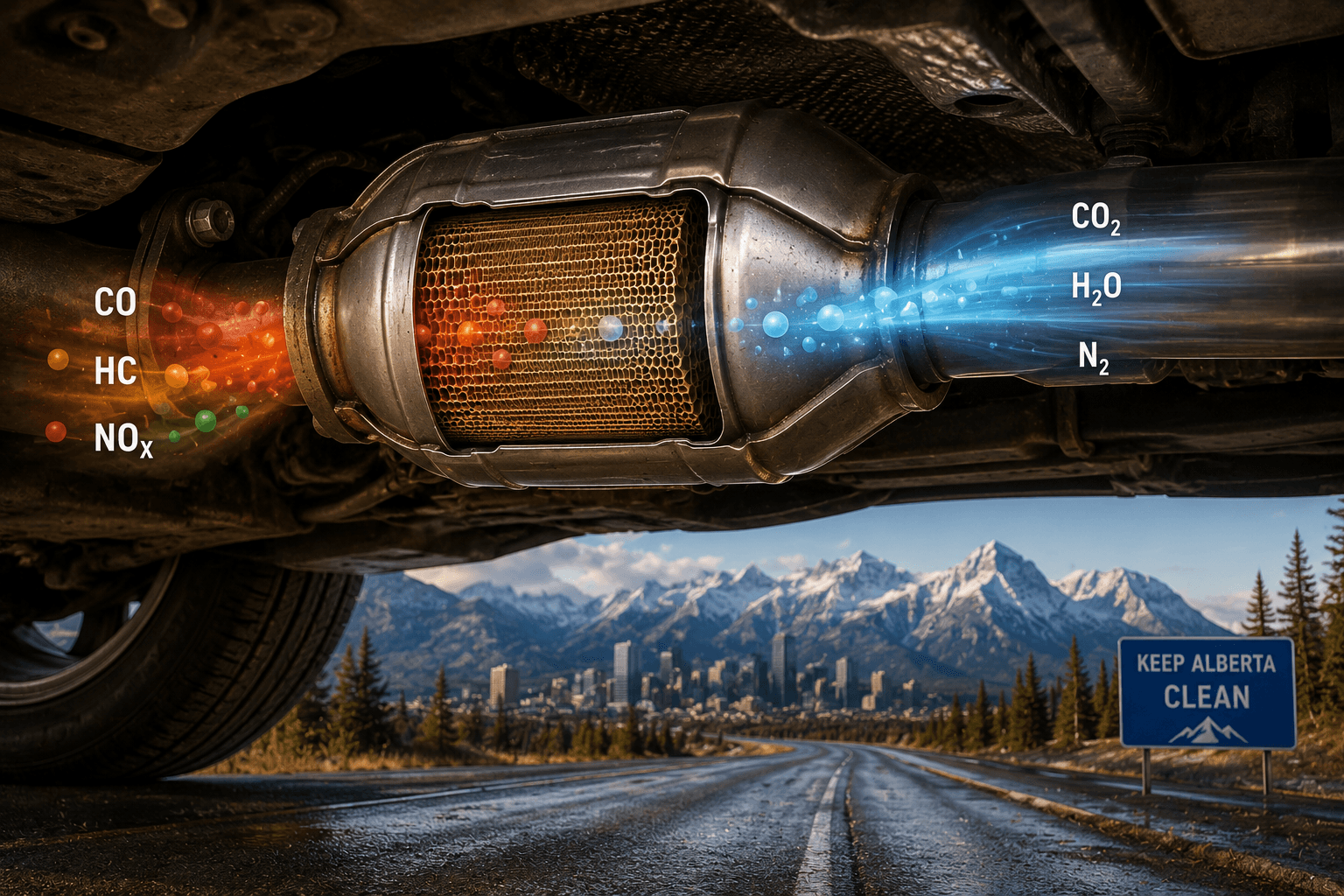
That's where the converter comes in. Inside that dented-looking metal can bolted to your exhaust is a honeycomb structure, and that honeycomb is coated in a really thin layer of some very expensive metals — platinum, palladium, and rhodium. When hot exhaust hits that coating, a chemical reaction happens. The bad gases get rearranged into things that aren't as harmful. Carbon monoxide turns into CO2. Nitrogen oxides split back into nitrogen and oxygen. Leftover fuel gets finished off into water and CO2.
All of that happens in maybe half a second, on repeat, every time you drive. No moving parts. No filter to change. Just a little chemistry lab bolted under your car.
Why They Cost So Much
Look at that ingredient list again. Rhodium has, at times, been worth more than ten times what gold goes for. Palladium isn't far behind. There's only a few grams of it inside each converter, but a few grams is enough that thieves with a battery-powered reciprocating saw can cut one off a truck in under two minutes and walk away with a few hundred bucks.
That's also why replacing one hits so hard. Somewhere between $1,500 and $3,000 installed for most cars. Trucks and hybrids can push past four grand. The part itself isn't complicated to make — the ingredients are just genuinely expensive.
Alberta Is Rough On Them
Here's the part that hits close to home. Converters have a harder life here than they do almost anywhere else.
For starters, they need to be hot to work. Really hot — around 400°C is when the chemistry kicks in properly. Now think about a typical winter morning. It's minus 22, you start the car, drive six minutes to Tim's, then six minutes to work. That converter never fully warms up. So you're basically running raw exhaust through it for months at a time, and the coating inside slowly degrades because it's not doing its job efficiently.
Then there's what we spray on the roads. Salt, calcium chloride, whatever brine the city's using this year — it's murder on exhaust systems. Your converter can be perfectly fine on the inside and still fail because the outer shell rusted through and cracked. I've seen converters that looked like Swiss cheese from underneath while the honeycomb inside was still clean.
Fuel plays a role too. If your engine's burning oil, or you've been filling up with the cheapest stuff you can find, that residue coats the honeycomb from the inside. It's like caking mud onto a coffee filter. Eventually nothing gets through the way it should.
How To Tell Yours Is Going
Converters rarely die overnight. They give hints first, and if you catch the hint you can sometimes save the converter by fixing whatever's actually causing the problem.
Check engine light is the big one. If your mechanic scans it and sees a P0420 or P0430 code, that's the computer saying the converter isn't scrubbing the exhaust as well as it used to. Doesn't always mean the converter itself is dead — sometimes it's a lying oxygen sensor — but it's worth looking into before it gets worse.
If you're smelling rotten eggs out the back of your car, that's sulfur that isn't getting processed. Not a good sign.
Loss of power is another one. If merging onto the Henday feels like your car is wheezing, or you're getting worse gas mileage for no reason, a partially clogged converter might be the reason. Your engine's basically trying to exhale through a pinched straw.
And if you hear rattling — like there's a can of nails loose under your car — the honeycomb inside has broken up. Once that starts, pieces can get sucked backward into the engine and do damage that costs way more than just the converter. Don't drive on it long once it starts rattling.
Keeping Yours Alive Longer
There's no scheduled maintenance for these things, but a few habits make a real difference.
Don't ignore engine problems. A misfire you've been putting off, a bit of oil burning, a rough idle you keep meaning to get looked at — all of that dumps unburned fuel into the converter, where it ignites and slowly cooks the coating off. I've watched people destroy a $2,500 part because they didn't want to spend $200 on ignition coils.
Skip the long warm-up in the driveway. It doesn't help. The converter needs load to heat up properly, and idling doesn't provide it. Just drive gently for the first few minutes instead.
And park smart if you can. Trucks and SUVs get hit the most because there's room underneath for a thief to work. A garage is best. A well-lit driveway is second best. Some shops in Calgary and Edmonton will install a shield or cage over the converter, and there are etching programs that make stolen units harder to sell. Not foolproof, but every extra minute of work is a minute a thief usually isn't willing to spend.
When It's Not Worth Fixing
Here's the honest talk. If you're driving a fifteen-year-old car worth maybe three grand on a good day, and the converter dies along with a couple of other things, replacing it doesn't make sense. You'd be spending more than the car's worth to keep it on the road, and the next thing will break six months later anyway.
At that point most people around here just cut their losses. Some try to sell it privately with full disclosure. Some part it out. A lot just call a scrap or auto recycler, take the payout, and move on. The car gets recycled properly, the metals actually get recovered, and you're not staring at a dead vehicle in your driveway all winter.
Bottom Line
That funny-looking canister under your car is doing more work than most parts on the whole vehicle. Quietly, constantly, no complaints. Take care of the engine feeding it, watch for the early warning signs, and take theft seriously — especially in a province where cold starts and salted roads are already trying to kill it.
Look after it and it'll probably outlast plenty of other things on your car. Ignore it, and it'll get your attention the expensive way.